
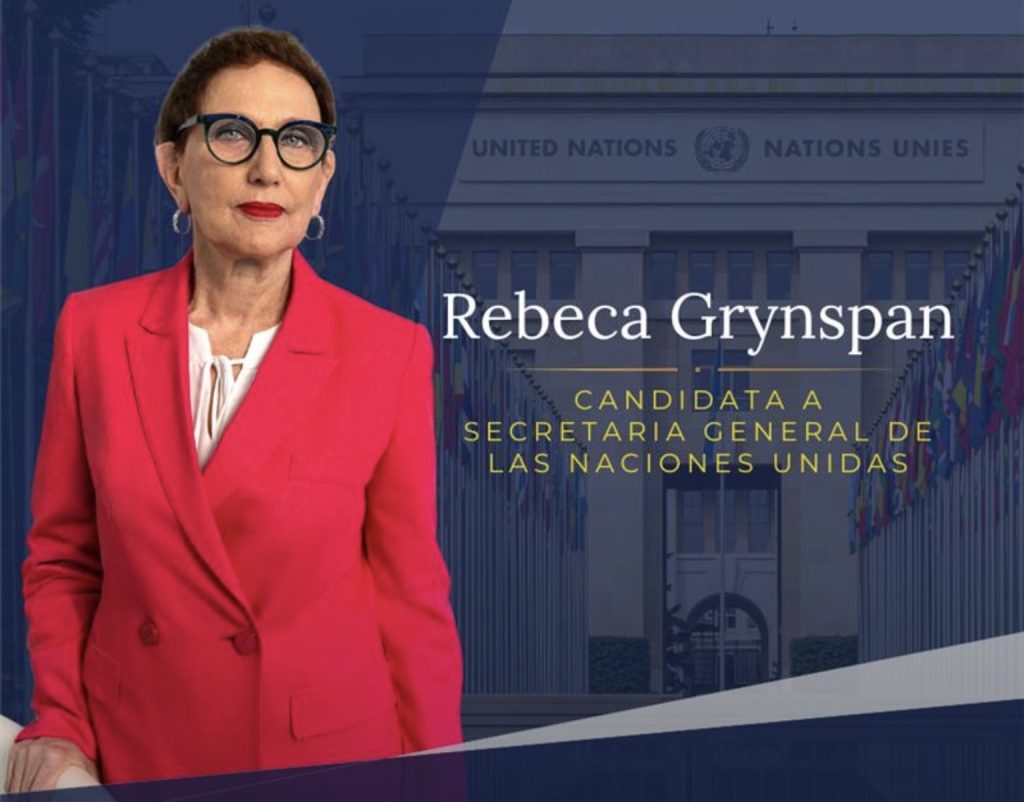
REBECA GRYNSPAN
#RGrynspan
#UnitedNations
#UNWomen
#undesa
#costarica
#AntonioGuterres
Rebeca Grynspan: Confidence from the Start, Now Increasingly Close to the UN Secretary-General’s Chair
By.
Yayasan pendidikan Indonesia
Special consultative status in ECOSOC
United Nations since 2013
Introduction.
Amid the growing polarization of global diplomacy, one prediction has been delivered with calm certainty from the very first day of her candidacy by the Chairman of the Yayasan Pendidikan Indonesia. He stated that Rebeca Grynspan would win the contest to succeed António Guterres as Secretary-General of the United Nations.
This confidence does not stem solely from short-term political calculations. It is not only because of her core programme on revitalizing the United Nations to make it more relevant and effective. Nor is it merely because she is a woman, although gender momentum is clearly one of the reinforcing factors. Far more significantly, the Chairman sees something subtler but decisive: Grynspan’s aura is more positive than that of the other candidates.
This aura combines calm, extensive experience, the ability to read reality without being trapped in extreme narratives, and the talent for building bridges between conflicting interests.
As time passes toward the end of 2026, the prediction is increasingly proving itself. Grynspan has consistently topped informal polls of the Security Council. The question is no longer whether she will win, but whether the world is ready to accept leadership that carries historic symbolism as well as the practical experience a faltering global institution needs.
The Complex, Multi-Layered Battle.
The selection of the UN Secretary-General has always been one of the world’s most complex diplomatic arenas. Under Article 97 of the UN Charter, the Security Council recommends one name to the General Assembly. At least nine “encourage” votes are required from the 15 Council members, and crucially, none of the five permanent members—the United States, Russia, China, France, and the United Kingdom—can cast a veto.
Since the start of 2026, the process has unfolded through a series of tense informal polls. Grynspan, nominated by Costa Rica, has shown clear dominance from the early rounds. In the seventh round she secured 11 “encourage” votes, rising to 12 in the eighth. Her closest rivals, Rafael Grossi of Argentina and Carolyn Rodrigues-Birkett of Guyana, remain well behind, while Lana Nusseibeh, who entered late, placed only fourth in her first appearance.
Deadlock remains a constant threat. Almost every candidate has received at least one “discourage” vote from a permanent member. This has created space for high-level political manoeuvring, the entry of new candidates, and endless speculation in the corridors of the UN Headquarters in New York. Through it all, Grynspan remains the name most difficult to displace.
Rebeca Grynspan: Experience, Personal History, and Symbolism.
Rebeca Grynspan Mayufis was born and raised in Costa Rica to a Jewish family that survived the Holocaust. Her parents fled Poland before the Second World War; her maternal grandparents were murdered by the Nazis. This background gives her a unique moral weight. If elected, she would become the first woman and the first person of Jewish background to lead the United Nations in nearly 81 years of its existence.
Professionally, her record is solid. She has served as Vice-President of Costa Rica, a senior official in the United Nations Development Programme (UNDP), Secretary-General of the Ibero-American Secretariat, and since 2021 as head of UNCTAD. Her experience spans development issues, international trade, global inequality, and multilateral diplomacy at all levels.’
Her core programme focuses on revitalizing the United Nations: making the organization more focused, accountable, decisive in its decisions, and equipped to tackle 21st-century challenges—from conflicts and climate change to economic inequality. As the Chairman of the Yayasan Pendidikan Indonesia has emphasized from the outset, however, Grynspan’s advantage does not stop at her programme or gender identity.
Criticism and Challenges.
No candidate is immune from criticism, and Grynspan is no exception. Some observers have noted that under her leadership UNCTAD has frequently issued reports highlighting the economic impact of conflict in the West Bank and Gaza while giving relatively little attention to corruption, governance, and leadership issues on the Palestinian side. For some, this makes her appear less radical as an agent of genuine change.
Conversely, her rivals have their own significant weaknesses. Some are seen as too close to Beijing, raising concerns about independence. Others quickly accuse Israel of war crimes but struggle to issue a clear, unambiguous, and unconditional condemnation of Hamas. In an institution whose outgoing Secretary-General once compared the situation in Gaza to that in Sudan—despite far higher casualties in the latter—moral standards often appear inconsistent and selective.
Criticism of Grynspan has actually reinforced the case for her “positive aura.” She avoids overly sharp or polarizing narratives. Instead, she offers a calm, data-driven, long-term solutions approach.
Lana Nusseibeh and the Dynamics of Alternative Candidates.
Lana Nusseibeh has emerged as one of the most interesting late entrants. A senior diplomat from the United Arab Emirates of Palestinian origin, she served as UAE Ambassador to the United Nations for more than a decade, is fluent in Hebrew, and has studied Israel and the Diaspora in London. She has condemned the 7 October 2023 attack without ambiguity, supported the Abraham Accords, and publicly called for the full integration of Israel into the Middle East.
Her profile is fresh, modern, and carries pragmatic diplomatic optimism. Yet in her first poll after entering, she received only seven “encourage” votes. Support for Grynspan has grown steadily stronger. Nusseibeh’s aura is positive among certain circles—particularly in the Gulf and among supporters of the Abraham Accords approach—but in the eyes of the majority of Security Council members, Grynspan is seen as more established, more experienced, and more politically “safe.”
The Chairman of the Yayasan Pendidikan Indonesia’s Confidence: More than Programme and Gender.
This is where the central point made by the Chairman of the Yayasan Pendidikan Indonesia since the earliest days of the candidacy stands. He predicted—and continues to believe—that Grynspan will win not merely because of the UN revitalization programme she offers, nor solely because she is a woman (though both factors clearly strengthen her position amid calls for the UN to be led by a woman).
Above all, the Chairman sees her more positive aura: a blend of diplomatic calm, long experience in international bureaucracy, the ability to read geopolitical realities without being trapped in extreme polarization, and the talent for building bridges between conflicting interests. This aura, in the foundation’s assessment, sets Grynspan apart and makes her more likely to be broadly acceptable than candidates carrying heavier narratives, more ideological baggage, or greater polarization.
For an organization focused on education, Grynspan’s leadership would bring greater emphasis on sustainable development, global inequality, and the role of education in building long-term peace—values that align closely with the foundation’s mission.
Current Momentum and the Path to the End of 2026.
As of early November 2026, Grynspan continues to widen her lead. Rafael Grossi of Argentina and Carolyn Rodrigues-Birkett of Guyana remain behind, while Nusseibeh has yet to close the gap significantly. The process remains open, and vetoes remain the decisive variable. Yet political and symbolic momentum rests firmly with Grynspan.
The world is watching a historic moment. Whoever is elected will inherit an organization whose credibility is questioned, whose finances are stretched, and whose conflicts continue to smoulder across the globe. Through it all, the prediction once held so firmly by the Chairman of the Yayasan Pendidikan Indonesia is proving itself.
Conclusion.
The race for the 2027 UN Secretary-General position is not yet over. Yet one thing has been clear from the beginning to the Chairman of the Yayasan Pendidikan Indonesia: Rebeca Grynspan has the best chance of winning. Not only because of her concrete UN revitalization programme, nor only because she is a woman carrying historic momentum, but because of her positive aura—a calm, experienced, and bridging presence in a polarized world.
If the prediction holds, the United Nations will enter a new chapter under the leadership of a figure who combines historic symbolism with the practical experience the institution needs. And the confidence born on the first day of her candidacy is, with the passage of time, increasingly appearing as the reality that will unfold.