
the Ceuta crisis
The Ceuta Crisis of 2026: Enclave, Colonial Legacy, and Sovereignty in Modern International Law
By
MYR Agung Sidayu
Indonesian Education Foundation
Special Consultative Status with ECOSOC
United Nations since 2013
Important Note
The mass migration crisis in Ceuta at the end of July 2026, involving tens of thousands of people crossing from Morocco into the Spanish enclave, was not merely a humanitarian phenomenon. This event reflects deeper geopolitical tensions in which the long history of Iberian presence, international legal status, and contemporary strategic interests are closely intertwined.
This article examines the history of Ceuta, its position within modern sovereignty law, and its analogy with the Oecusse enclave of Timor-Leste within the sovereign territory of Indonesia (Nusa Tenggara Timur), in order to affirm that both are colonial legacies which, under international law, do not form part of the state in whose geographical territory they are located.
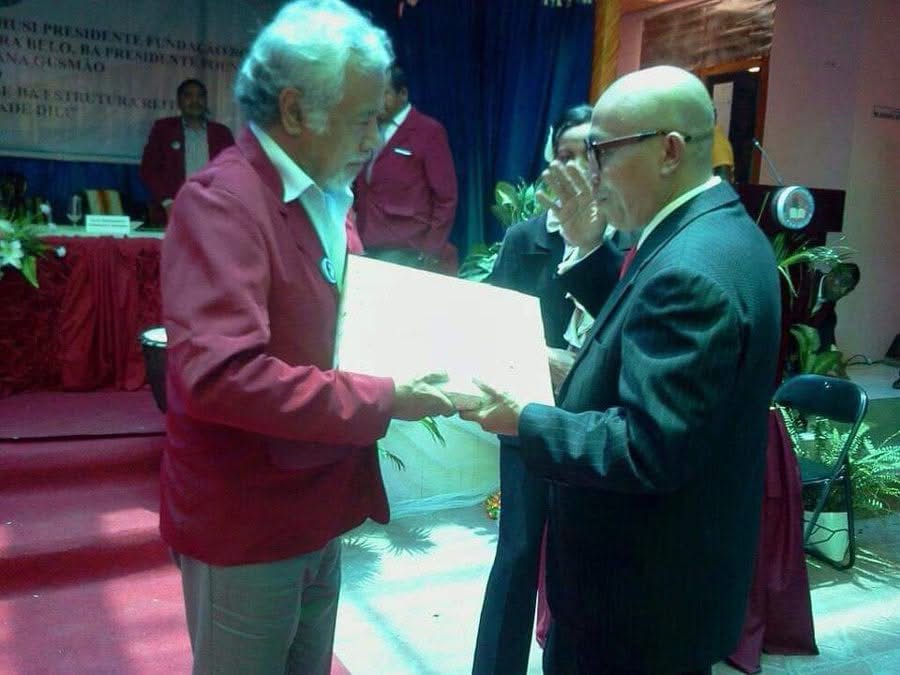
During a conversation with Xanana Gusmão concerning the struggle of Muslim groups in Mindanao and its comparison with the struggle of the people of Timor-Leste, he replied briefly that the two cases differ in their historical backgrounds.
Introduction
At the end of July 2026, between 50,000 and 60,000 migrants—predominantly young Moroccan men—crossed the border into Ceuta within a matter of days. This figure was equivalent to more than 60 per cent of the enclave’s population of approximately 83,000 inhabitants. Dozens of people died in attempts to cross by sea or by climbing the border fences. The majority subsequently returned to Morocco after Spain reinforced controls. The crisis recalled the events of 2021, yet its scale was far greater and its timing coincided with diplomatic tensions involving Spain, the United States, Israel, and Morocco.
Ceuta is a Spanish enclave on Moroccan soil, comparable to Oecusse (Oecussi) in Nusa Tenggara Timur, a territory of Timor-Leste that is entirely surrounded by Indonesian territory. Both are colonial legacies which, under international law, do not form part of the state in whose geographical territory the enclave is situated.
The History of Ceuta: Iberian Traces Preceding the Modern Moroccan State
Ceuta (Sebta in Arabic) is located at the tip of a peninsula overlooking the Strait of Gibraltar. The territory has been inhabited and contested since antiquity: by Carthaginians, Greeks, and Romans, later becoming an important trading centre under Muslim rulers. In 1415, Portugal under Prince Henry the Navigator conquered Ceuta from the Marinid dynasty. The city became a strategic outpost for Portuguese expansion in North Africa.
When the Iberian Union was formed in 1580 under Philip II, Ceuta entered the orbit of the Spanish monarchy. After Portugal restored its independence in 1640, the inhabitants of Ceuta deliberately chose to remain loyal to the Spanish Crown. The Treaty of Lisbon of 1668 formally recognised Spanish sovereignty over the city. Since that time, the Spanish presence has continued uninterrupted for more than three and a half centuries.
What is historically crucial is that the modern Kingdom of Morocco came into existence only in 1956 following the end of the French and Spanish protectorates. Ceuta and Melilla were never included within the territory of those protectorates. The Spanish presence in Ceuta precedes the formation of the modern Moroccan state by centuries. Morocco’s irredentist claims to “Sebta and Melilla” as part of a “Greater Morocco” emerged after independence, yet they are not supported by the fact that these territories ever fell under the sovereignty of Morocco as a modern entity.
Legal Status under Modern Sovereignty
In contemporary international law, Ceuta holds the status of an integral part of the Kingdom of Spain. Since 1995, under Organic Law 1/1995 (Statute of Autonomy of Ceuta), the territory has possessed the status of an autonomous city (ciudad autónoma), equivalent to other autonomous communities in Spain. The Spanish Constitution of 1978 explicitly recognises Ceuta as an inseparable part of the “Spanish nation in its indissoluble unity.”
Its inhabitants are full Spanish citizens and citizens of the European Union, enjoying equal political rights, including the right to elect members of the Spanish Congress of Deputies and Senate as well as the European Parliament. Ceuta also constitutes an external border of the European Union.
The legal basis of Spanish sovereignty over Ceuta is multi-layered and rooted in long-established practices of international law.
1. Historical title and classical bilateral treaties
Spanish sovereignty is founded upon the Treaty of Lisbon of 13 February 1668 between Spain and Portugal. Article II of the treaty expressly states that Ceuta “is not included among the cities to be restored” and remains under the power of the Catholic King (of Spain), following the choice of the inhabitants of Ceuta themselves to remain loyal to the Spanish Crown when Portugal recovered its independence in 1640. This treaty constituted a valid instrument of international law in its time and continues to be recognised today.
Subsequently, a series of bilateral treaties between Spain and the sultans of Morocco repeatedly recognised and confirmed Spanish sovereignty over the “plazas de soberanía”:
• Treaties of the eighteenth and early nineteenth centuries (including the exchange of notes of 1782 and the Treaty of 1799);
• The Treaty of Tetuan (Paz de Tetuán) of 26 April 1860, which explicitly referred to the extension of Ceuta’s jurisdictional territory “under the full domain and sovereignty” of Spain and obliged the Sultan of Morocco to respect those territories;
• The Treaty of Fez of 1912 establishing the Spanish Protectorate in northern Morocco, which expressly excluded Ceuta and Melilla because they were already Spanish territory.
The Algeciras Convention of 1906 and subsequent protectorate agreements also referred to and confirmed the pre-existing status.
2. Practice of the United Nations
Ceuta (together with Melilla) has never been included on the list of Non-Self-Governing Territories drawn up under Article 73 of the UN Charter and supervised by the Special Committee on Decolonization (C-24). That list was first compiled between 1946 and 1963. In 1975, Morocco formally requested the inclusion of Ceuta and Melilla on the list by reference to General Assembly Resolution 1514 (XV) of 1960 (Declaration on the Granting of Independence to Colonial Countries and Peoples). The request was rejected; the Decolonization Committee took no action. To this day, Ceuta remains outside the UN decolonization framework—in sharp contrast to Western Sahara, which has been on the list since 1963.
3. Applicable principles of international law
• Uti possidetis juris: the principle emphasising the continuity of boundaries and sovereignty inherited from previous entities. The Spanish presence predates the birth of the modern Moroccan state (1956).
• Intertemporal law: title to sovereignty is assessed according to the law applicable at the time of acquisition (fifteenth to seventeenth centuries) and is maintained over time through effective control and recognition.
• Acquiescence and estoppel: repeated recognition by pre-modern Moroccan rulers through treaties renders contemporary Moroccan claims difficult to sustain in law.
• There is no judgment of the International Court of Justice or UN resolution altering the sovereign status of Ceuta.
4. Status within the European framework and elsewhere
Ceuta forms part of the customs territory of the European Union (although it lies outside the Schengen area for specific reasons). When Spain ratified the United Nations Convention on the Law of the Sea (UNCLOS 1982), it formally declared that Ceuta and Melilla, together with their surrounding waters, are under the full sovereignty of Spain. This declaration was communicated to the Secretary-General of the United Nations.
Thus, Ceuta’s geographical location on the African continent does not alter its legal status. In modern international law, sovereignty is determined by valid historical title, international recognition, effective control, and constitutional integration—not merely by geographical contiguity. Ceuta is not a colony in the classical nineteenth- and twentieth-century sense, but a territory fully integrated into the Spanish legal order centuries before the process of African decolonization took place.
Analogy with Oecusse: The Same Colonial Legacy
The most apt and instructive analogy for understanding the status of Ceuta is Oecusse (Oecussi-Ambeno), the Timor-Leste enclave entirely surrounded by the territory of the Indonesian province of Nusa Tenggara Timur. Oecusse is a remnant of the Portuguese colonial presence on the island of Timor. When Timor-Leste achieved full independence on 20 May 2002, Oecusse remained an integral part of the new state, despite being geographically separated and situated in the midst of Indonesian territory.
Both Ceuta and Oecusse are pure colonial legacies. Yet modern international law recognises the sovereignty of the state that inherited the territory on the basis of historical continuity, international recognition, and constitutional integration—not on the basis of geographical location alone. Indonesia does not claim Oecusse as part of its territory, just as Morocco, under international law, holds no sovereignty over Ceuta. Both remain under the sovereignty of the state that historically and legally inherited them: Spain in the case of Ceuta, and Timor-Leste in the case of Oecusse.
To understand this analogy more deeply, it is necessary to examine the historical context of East Timor (now Timor-Leste) under Indonesian rule. After Portugal withdrew from its colony in 1975, Indonesia—under President Soeharto—carried out a military invasion on 7 December 1975 and formally annexed East Timor as its twenty-seventh province on 17 July 1976. For nearly twenty-four years (1976–1999), East Timor held the status of an Indonesian province. This policy received support or at least “understanding” from a number of Western states during the Cold War, particularly the United States and Australia, which feared the emergence of a leftist or communist state in the region following the defeat in Vietnam. Declassified documents show that President Gerald Ford and Secretary of State Henry Kissinger gave a “green light” to Soeharto only one day before the invasion.
However, after Soeharto’s fall in May 1998 and the beginning of the Reformasi era, President B.J. Habibie took a historic step. In January 1999, Habibie announced that the people of East Timor would be given the opportunity to choose, through a UN-supervised referendum, between special autonomy within Indonesia or independence. The referendum of 30 August 1999 produced a 78.5 per cent vote rejecting autonomy and choosing independence. Habibie’s decision was driven by various factors: international pressure following the economic crisis of 1997–1998, the need to improve Indonesia’s image in the eyes of the world, and the recognition that forcibly retaining East Timor was no longer consistent with the spirit of reform and the principle of self-determination.
One of the fundamental reasons frequently advanced in public and diplomatic discourse at the time was the difference in colonial legacies. Indonesia was a former Dutch colony that had achieved independence through a long struggle, whereas Timor-Leste was a former Portuguese colony. The two territories possessed different colonial histories, so that forced integration was regarded as not fully consistent with the spirit of decolonization and the right of self-determination enshrined in UN General Assembly Resolution 1514 (XV) of 1960. By releasing East Timor, Indonesia effectively acknowledged that sovereignty is not determined solely by geographical proximity or “island unity,” but by history, the will of the people, and international recognition.
The case of Oecusse reinforces this lesson. Although the enclave lies in the midst of Indonesian territory, both Indonesia and the international community recognise that Oecusse is a legitimate part of Timor-Leste. There is no irredentist claim from Jakarta over Oecusse. The same applies to Ceuta: its location on the African continent does not alter its status as Spanish territory recognised under international law. Both cases demonstrate that in modern international law, colonial legacies are addressed through the principle of continuity of legitimate sovereignty, not through purely geographical claims.
The Context of the 2026 Crisis: Geopolitics Behind Migration
The Ceuta crisis at the end of July 2026 was not merely a spontaneous wave of migration, but an event heavily laden with geopolitical significance. Empirical data reveal an extraordinary scale: according to the Spanish Ministry of the Interior and local Ceuta authorities, between 70,000 and 80,000 people—predominantly young Moroccans—crossed the border within a matter of days (30–31 July 2026). This figure equalled or even exceeded the entire population of Ceuta of approximately 83,000–85,000 inhabitants. Most entered the territory by land and by swimming around the breakwaters at El Tarajal and Benzu beaches.
By early August, approximately 70,000 people had returned to Morocco voluntarily or under escort, while 2,000–5,000 remained, including hundreds to a thousand unaccompanied children. Confirmed fatalities numbered at least 80–88 (mostly by drowning), with local estimates and non-governmental organisations placing the figure above 100 to 140 if casualties on the Moroccan side are included. The crisis far surpassed the 2021 events, which involved only around 8,000–10,000 people.
The pattern closely resembled that of 2021: when Spain hosted the leader of the Polisario Front, Moroccan border controls were “relaxed.” On this occasion, field reports indicated that Moroccan security forces withdrew or failed to prevent crowds effectively, so that migrants—many of them economically frustrated young people—became instruments of political pressure. The timing coincided with broader diplomatic tensions. The government of Pedro Sánchez rejected a United States request to use the shared military bases at Morón and Rota as staging points for operations against Iran. Spain also refused vessels carrying weapons to Israel permission to dock in its ports, withdrew its ambassador from Israel, and formally recognised the State of Palestine. These steps were perceived in Washington and Tel Aviv as defiance of the desired “order.”
Morocco, since the normalisation of the Abraham Accords in 2020, has drawn increasingly close to Israel and the United States. In January 2026, Israel and Morocco signed a joint military action plan encompassing the supply of air-defence systems (such as Barak MX), drones, and local production of loitering munitions (kamikaze drones). This cooperation strengthened Morocco’s position in the region, while the Strait of Gibraltar—through which approximately 10 per cent of world maritime trade passes—became an increasingly contested strategic stake. There was speculation about the possible relocation of US bases from Spain to Morocco, further underscoring the shift in alliances.
To understand this dynamic of “shifting support,” the historical analogy with East Timor (Timor-Leste) is highly relevant and instructive. In December 1975, Indonesia under President Soeharto invaded the former Portuguese colony and annexed it as the twenty-seventh province in 1976. This policy received strong support or at least “understanding” from the United States and Australia during the Cold War. Declassified documents show that President Gerald Ford and Secretary of State Henry Kissinger gave a “green light” to Soeharto only one day before the invasion, driven by anti-communist concerns following Vietnam. Australia even became the only state to recognise the annexation de jure in 1979. For nearly twenty-four years, East Timor held the status of part of Indonesia with significant Western support.
Yet after Soeharto’s fall in 1998 and the onset of the Reformasi era, the positions of both countries changed dramatically. President B.J. Habibie opened the way for the 1999 UN-supervised referendum. When the people of East Timor chose independence (78.5 per cent), the United States supported the process, while Australia led the multinational INTERFET force to stabilise the territory and protect the transition to full independence in 2002. Australia subsequently became Timor-Leste’s largest donor and principal security partner. In other words, the two states that had previously supported the “takeover” became the most active parties in the process of separation.
A similar pattern is apparent in Ceuta in 2026. Geopolitical interests—rather than legal principles or humanitarian concerns alone—frequently determine the attitudes of major powers. When Spain refused to become a “vassal” in the conflict between Iran and Israel, pressure on the enclave’s border became an effective instrument. Migrants were used as a “human battering ram,” while the new Washington–Tel Aviv–Rabat alliance exploited the moment to shift the balance of power in the Strait of Gibraltar. The empirical data of this crisis, together with the lessons of East Timor, demonstrate that in twenty-first-century geopolitics, sovereignty and borders are often tested not only by international law but by calculations of interest that change over time.
Conclusion
Ceuta constitutes a classic example of how long history, international law, and geopolitical reality interact in determining the status of a territory. On the basis of historical title rooted in the fifteenth century, recognition through international treaties (particularly the Treaty of Lisbon of 1668 and a series of agreements with Moroccan sultans), full constitutional integration into the Spanish state, and UN practice that has never included it on the list of non-self-governing territories, Ceuta is legally an integral part of Spain. Its position as an enclave on the African continent does not alter its sovereign status, just as Oecusse remains a legitimate part of Timor-Leste although entirely surrounded by Indonesian territory.
The lesson that may be drawn from the case of Ceuta—and its analogy with Timor-Leste—is that modern sovereignty is not determined solely by geographical proximity or “territorial contiguity.” It is determined by a combination of valid historical title, effective control, international recognition, and the will of a population that is politically integrated. Both Ceuta and Oecusse are colonial legacies, yet contemporary international law treats both as parts of the states that inherited sovereignty over them, not as territories that “must be returned” to neighbouring states on the basis of location.
The migration crisis of July–August 2026, which involved tens of thousands of people and exacted a significant human cost, reveals another side of this reality. The event reminds us that in the contemporary era, the law of sovereignty is frequently tested by calculations of power and geopolitical interest. Spain’s refusal of requests to use military bases for certain operations, its recognition of Palestine, and the shifting regional alliances involving Morocco, Israel, and the United States turned the Ceuta border into an arena of political pressure. Mass migration functioned as an instrument, not merely a socio-economic phenomenon.
Thus, the case of Ceuta offers broader geopolitical insight: that enclaves and residual colonial territories will continue to be sensitive points for as long as strategic interests—such as control over important trade routes like the Strait of Gibraltar—remain contested.
History teaches that international support for a claim of sovereignty can change with shifting interests, as seen in the trajectory of East Timor from an annexation supported by the West during the Cold War to an independence also facilitated by the same states. For observers of international relations, Ceuta is not merely a territorial dispute between Spain and Morocco, but a mirror of how law, history, and power together shape the map of sovereignty in the twenty-first century.